
The U.S. Environmental Protection Agency’s proposed 2026 Multi-Sector General Permit (MSGP) for industrial stormwater is not yet final or enforceable. It remains in the proposal stage following public comment and will not take legal effect until EPA issues a final permit in the Federal Register. In the meantime, the 2021 MSGP, which expired on Feb. 28, 2026, continues in force under administrative continuance for facilities that previously obtained coverage.
Once finalized, the 2026 MSGP will establish the governing framework for the next five-year cycle. For industrial operators, this interim period is not a pause. This is a narrowing window to evaluate financial exposure, operational readiness and enterprise-level risk before the new requirements become enforceable.
The New Financial Reality of Stormwater Management
The 2026 MSGP would change both capital and operational budgeting. Facilities that delay evaluation until the effective date may need to react under compressed timelines.
Stricter design standards represent one of the most significant capital drivers. The proposed permit would require operators to design and evaluate stormwater controls capable of managing larger storm events to reflect EPA’s focus on climate resilience and durable infrastructure. For many facilities, compliance would require upgrades to treatment systems, including advanced media filtration, chemical-assisted clarification or expanded detention capacity, to consistently meet tighter benchmark monitoring standards.
Operational impacts would be equally substantial. The proposal would expand monitoring obligations across numerous sectors, including new indicator monitoring for per- and polyfluoroalkyl substances (PFAS). Benchmark monitoring would also broaden to include pollutants such as chemical oxygen demand (COD), ammonia and metals for additional industrial categories. With quarterly monitoring required during the initial permit term, sampling frequency alone would increase laboratory, analytical and consulting costs.
Expanded reporting requirements and more prescriptive corrective action timelines would further increase internal administrative burdens. Even before the permit becomes effective, operators should model these projected costs into multiyear financial planning scenarios.
Heightened Risk and Corporate Exposure
While the 2021 MSGP continues in effect under administrative continuance, the proposed 2026 framework signals a higher compliance threshold ahead. This could affect the company's reputation and its perception among investors.
The proposed framework outlines a more structured, tiered response process for benchmark exceedances with tighter deadlines and less flexibility in corrective action sequencing. The ability to attribute exceedances to “natural background” conditions would require formal EPA approval, limiting a defense that has historically been available in certain contexts.
Transparency amplifies these risks. Monitoring data submitted under National Pollutant Discharge Elimination System permits is publicly accessible, and the proposed permit reinforces unambiguous limits on visible indicators such as sheen, foam and floating solids. Exceedances, particularly those involving PFAS, can quickly draw attention from community groups, advocacy organizations and media outlets. Even though the new permit is not yet enforceable, organizations that begin strengthening internal controls now can reduce exposure when the final rule is issued.
The Imperative for a Proactive, Data-Driven Strategy
The transition period between proposal and finalization offers a strategic advantage. Facilities currently operating under the administratively continued 2021 MSGP have an opportunity to build infrastructure, systems and governance processes before new mandates take effect.
The expanded monitoring structure proposed for 2026 would generate substantial data volumes. Manual spreadsheets and fragmented tracking systems would be expected to struggle maintaining defensible reporting and corrective action timelines. A centralized environmental management information system (EMIS) is increasingly essential. Such systems support real-time data tracking, exceedance forecasting, automated reporting workflows and audit-ready documentation.
This approach enables broader integration of stormwater into enterprise planning. Rather than treating stormwater as an isolated compliance function, facilities can develop integrated water management strategies that align planning for stormwater, wastewater and process water. In some cases, this may create reuse efficiencies, infrastructure optimization or capital planning benefits that reduce long-term costs.
The key is timing. Organizations that wait for the final Federal Register publication may face accelerated implementation deadlines. Those that prepare during the proposal stage can sequence investments more deliberately.
A Strategic Path Forward
The proposed 2026 MSGP introduces complexity, but it also provides clarity regarding regulatory direction. Forward-looking operators can use this interim period to transition from reactive compliance to structured preparation.
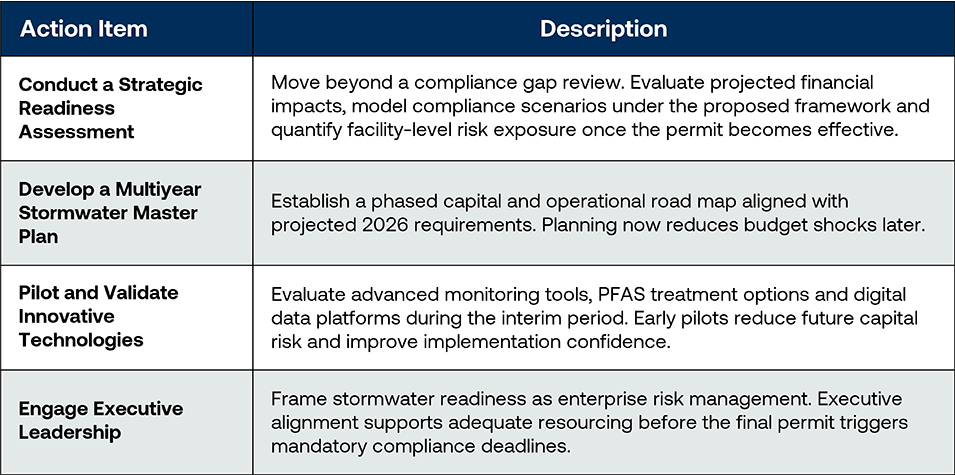
Figure 1: Strategic actions industrial operators can take to prepare for the proposed 2026 MSGP, including readiness assessments, multiyear planning, technology pilots and executive alignment.
Each of these actions strengthens organizational resilience. The proposal stage is not merely procedural — it is a preparatory phase.
A Partner in a Changing Landscape
The proposed 2026 MSGP represents a structural evolution in industrial stormwater regulation. Although the 2021 permit remains in effect through administrative continuance, the regulatory trajectory is evident. Facilities that use this period to align capital planning, data systems and governance processes will be better prepared for the transition.
